
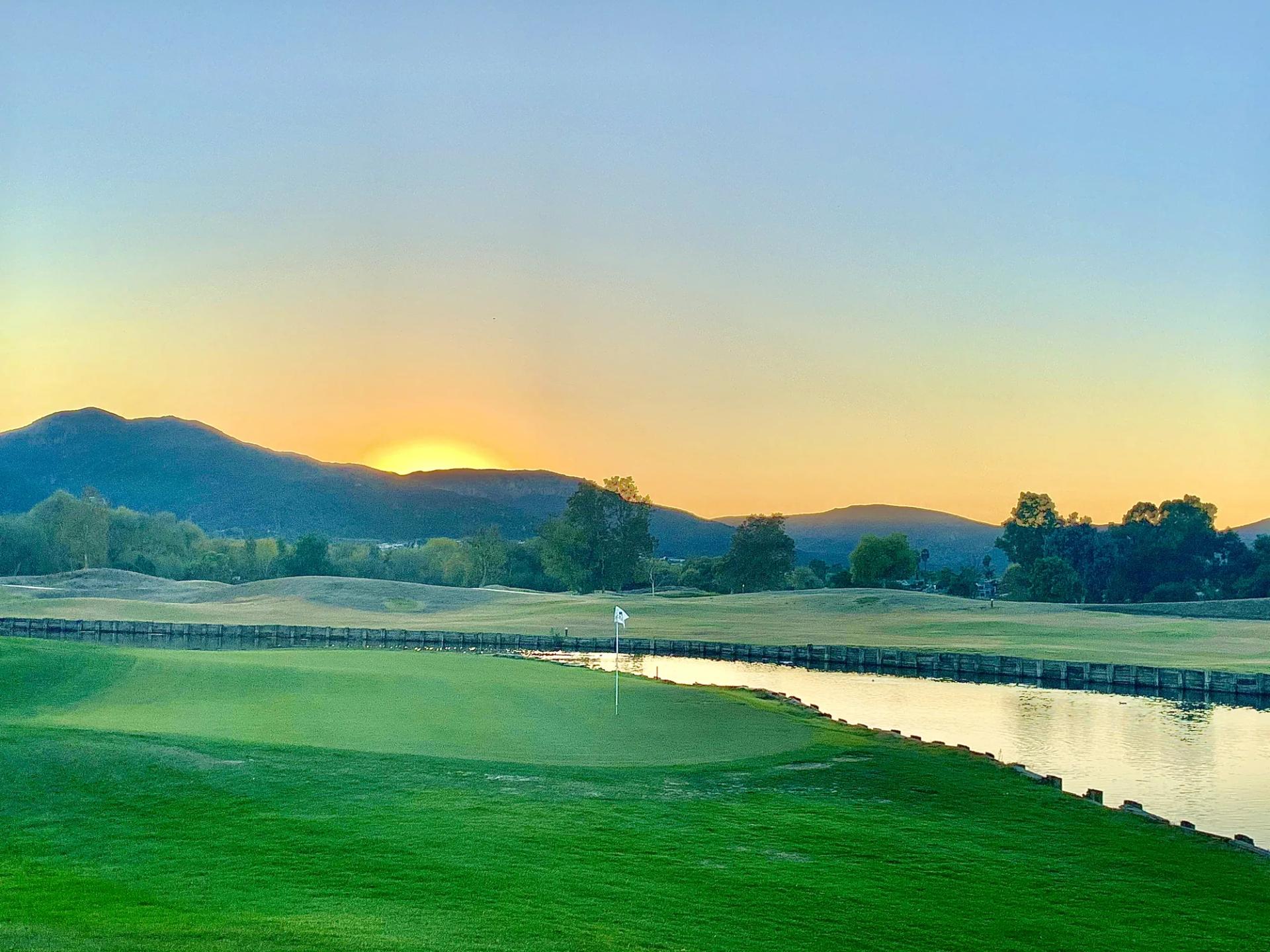
Public Play · San Diego
Carlton Oaks Golf ClubSantee
A Perry Dye-redesigned river-valley course in Santee, with railroad ties, pot bunkers and peninsula greens.
Par
72
Yardage
7,228
Rating · Slope
75.0 · 140
Holes
18
Green Fee
$26–$60
The Course
About Carlton Oaks Golf Club
Carlton Oaks is a public 18 in Santee, about 20 minutes from downtown San Diego, laid out in a river valley with a meandering creek, mature trees and lakes. From the Black tees it plays 7,228 yards with a 75.0 rating and 140 slope, while six sets of tees reach down to about 5,000 yards. Walking is allowed, cart renters must be 18 with a driver's license, and the Carlton Oaks Lodge on site makes it a stay-and-play option.
History
Carlton Oaks Golf Club — History
Golf at Carlton Oaks dates to 1958, and Perry Dye, son of Pete Dye, totally renovated the course in 1989. It hosted the 1974 NCAA Championship, which Wake Forest won when Curtis Strange hit a one-iron to seven feet on the 72nd hole and made the eagle putt. Later events include first-stage PGA TOUR Q-School in 2010 and U.S. Open and U.S. Amateur qualifiers, and Phil Mickelson played here growing up.
Design
Carlton Oaks Golf Club — Design
Perry Dye used his family's signatures: pot bunkers, bunkers lined with railroad ties, large waste areas, mounding and peninsula greens held in by bulkheads, all laid over a river-valley site of creek, lakes and mature trees. GolfNow notes that the fairways narrow in spots and that the large greens, full of double breaks, reward approaching from the proper angle. The original 1958 course was parkland in style, a contrast to San Diego's canyon layouts.
What Sets It Apart
Why Play Carlton Oaks Golf Club
Carlton Oaks is a public Perry Dye design, the course where Phil Mickelson honed his game as a junior and where Curtis Strange won the 1974 NCAA title.
The Round
The Journey at Carlton Oaks Golf Club
I.
The Opening
The 445-yard 1st asks for two good shots from the start, and the 181-yard 2nd is the first of four par 3s. The 558-yard 3rd is the first par 5, followed by the 469-yard 4th, the longest par 4 and the No. 1 handicap. Then the card relents: the 312-yard 5th is the shortest par 4 and the No. 17 handicap, before the 435-yard 6th, rated No. 5.
II.
The Middle
The 211-yard 7th is the longest par 3, and the 403-yard 8th is the No. 3 handicap before the 543-yard par-5 9th closes a 3,557-yard front nine. Locals call the 10th through 12th The Oak Trap. The 460-yard 10th leads to the signature pair, the 409-yard 11th and the 199-yard 12th, which sit on opposite sides of a pond with peninsula greens held in by bulkheads.
III.
The Finish
GolfNow rates the stretch after the pond as the most enjoyable on the course, with the holes playing among cottonwood trees. The 611-yard 13th is the longest hole and the 460-yard 14th the No. 2 handicap. After the 577-yard 15th come the 368-yard 16th, the easiest hole on the card, and the 148-yard 17th. The closing hole was a 540-yard par 5 when Strange eagled it in 1974; the 18th is a 439-yard par 4 now.
How to Play It
Carlton Oaks Golf Club — Playing Strategy
Beginner / High Handicap
With a 75.0 rating and 140 slope from the Black tees, Carlton Oaks is long for a first visit, so choose one of the forward sets. Treat the 312-yard 5th and the 368-yard 16th, the two easiest holes, as scoring chances, and on the 12th aim for the middle of the peninsula green rather than the flag.
Intermediate / Mid Handicap
Bogey is a fine score on the 4th, 14th, 8th and 18th, the four hardest holes, and three of the par 5s run past 550 yards, so plan them as three-shot holes. Dye's fairways narrow in spots, so a fairway wood off the tee is often the smarter play. On approach, think about angles: the greens are large and tricky to read, with plenty of double breaks.
Advanced / Low Handicap
From 7,228 yards the par 5s are where low rounds are built, though the 611-yard 13th is the longest hole on the card. Through The Oak Trap, place drives on the side of the fairway that opens the best angle to the bulkheaded greens on the 11th and 12th. Two-putting the large, double-breaking greens is the other half of scoring here.
Signature Holes
Carlton Oaks Golf Club — Signature Holes
The Card
Carlton Oaks Golf Club Scorecard
| Hole | 1 | 2 | 3 | 4 | 5 | 6 | 7 | 8 | 9 | Out | 10 | 11 | 12 | 13 | 14 | 15 | 16 | 17 | 18 | In | Total |
|---|---|---|---|---|---|---|---|---|---|---|---|---|---|---|---|---|---|---|---|---|---|
| Par | 4 | 3 | 5 | 4 | 4 | 4 | 3 | 4 | 5 | 36 | 4 | 4 | 3 | 5 | 4 | 5 | 4 | 3 | 4 | 36 | 72 |
| Yards | 445 | 181 | 558 | 469 | 312 | 435 | 211 | 403 | 543 | 3,557 | 460 | 409 | 199 | 611 | 460 | 577 | 368 | 148 | 439 | 3,671 | 7,228 |
| Handicap | 7 | 11 | 15 | 1 | 17 | 5 | 9 | 3 | 13 | — | 6 | 12 | 8 | 10 | 2 | 14 | 18 | 16 | 4 | — | — |
Good to Know
Carlton Oaks Golf Club — questions answered
- How do I book a tee time at Carlton Oaks Golf Club?
- Find and book live tee times at Carlton Oaks Golf Club through GolfNow — Golf in CA links straight to its tee sheet on this listing.
- How much does it cost to play Carlton Oaks Golf Club?
- Green fees at Carlton Oaks Golf Club are typically $26 to $60, varying by season, day of week and time. Confirm current rates when you book.
- Who designed Carlton Oaks Golf Club?
- Carlton Oaks Golf Club was designed by Perry Dye and opened in 1958.
- What is the par and yardage at Carlton Oaks Golf Club?
- Carlton Oaks Golf Club plays to a par of 72 over 7,228 yards from the championship tees, with a course rating of 75.0 and a slope of 140.
- Is Carlton Oaks Golf Club public or private?
- Carlton Oaks Golf Club is open to public play. Tee times can be reserved in advance.
- Where is Carlton Oaks Golf Club located?
- Carlton Oaks Golf Club is located at 9200 Inwood Dr, Santee, CA 92071, in the San Diego area of California.
More in San Diego
More golf courses in San Diego
Ted Robinson · El Cajon
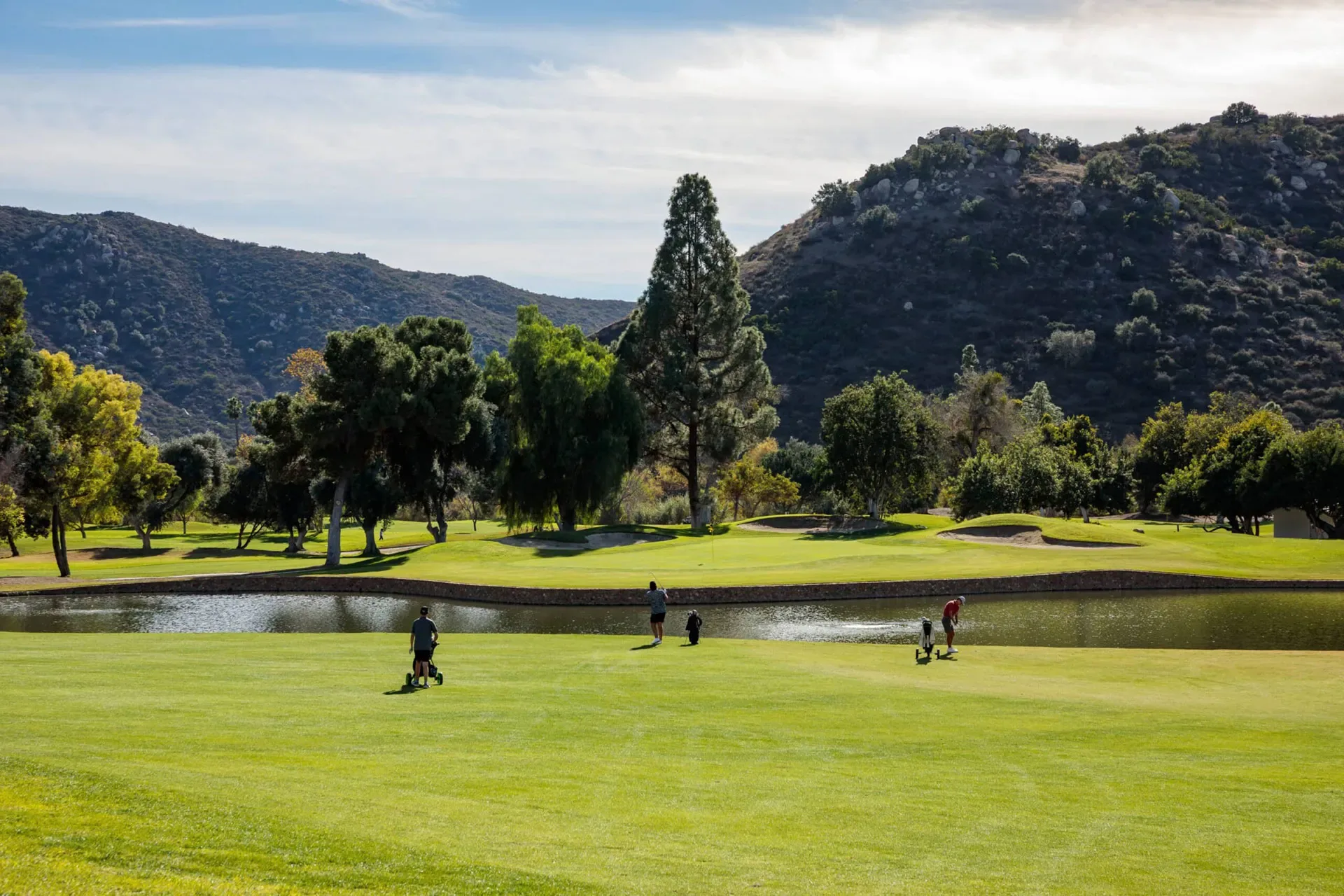
Singing Hills at Sycuan — Willow Glen
Singing Hills' Willow Glen, a Ted Robinson layout along the Sweetwater River in the Dehesa Valley.
Gary Roger Baird · Lakeside
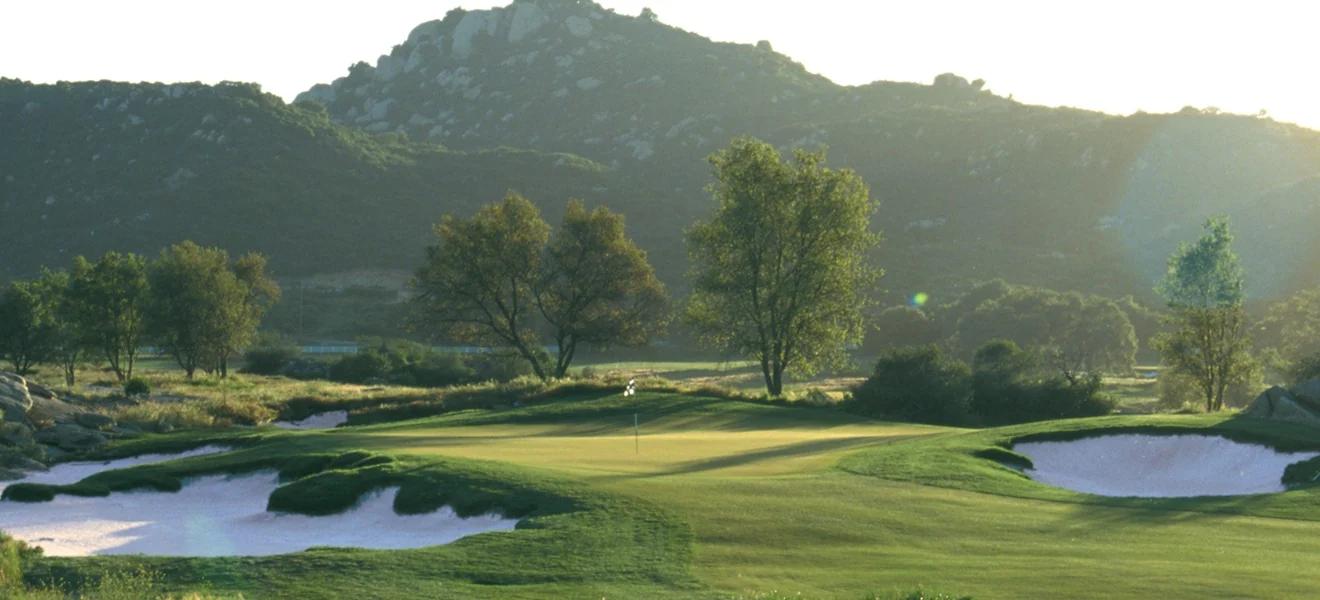
Barona Creek Golf Club
Barona Resort's championship course, routed through oak-dotted foothills on the Barona Indian Reservation near Lakeside.

Tom Fazio · San Diego
The Grand Golf Club
Tom Fazio's canyon course beside the Fairmont Grand Del Mar resort in San Diego.
How to Play It
Book a Tee Time at Carlton Oaks Golf Club.
Find and book live tee times at Carlton Oaks Golf Club on GolfNow.
Golf in CA is an independent guide — we don’t sell tee times or mark them up. We map the exact way on.
Make a Day of It
Dining & nightlife around your round.
Pair Carlton Oaks Golf Club with the best dining and table service in San Diego through MyRSVP — our sister guide to San Diego dining and nightlife.
Explore MyRSVP ↗