
Where to Play
Monterey Peninsula Golf: Pebble Beach & Beyond
What a visitor can actually play around Monterey Bay, from Pebble Beach to Pasatiempo.
Updated · November 6, 2026
The Monterey Peninsula is where California golf gets its reputation. Pebble Beach Golf Links, Spyglass Hill and Cypress Point share a few miles of shoreline and pine forest in Pebble Beach, and getting onto them is a separate problem from choosing between them. Cypress Point is private, and the best-known public course in the group ties its tee times to a hotel room. This guide is for visiting golfers sorting out what they can actually play, from the Pebble Beach Resorts courses outward to Seaside, Carmel Valley, Santa Cruz and Hollister, with the private clubs last.
The Pebble Beach Resorts courses
Three of the Pebble Beach Resorts courses are in this guide, and they do not book the same way. The operator's page for Pebble Beach Golf Links states that its tee times come with a hotel-stay requirement, which generally means a room at The Lodge at Pebble Beach, The Inn at Spanish Bay or Casa Palmero. The pages for Spyglass Hill and Del Monte carry no such notice.
Pebble Beach Golf Links
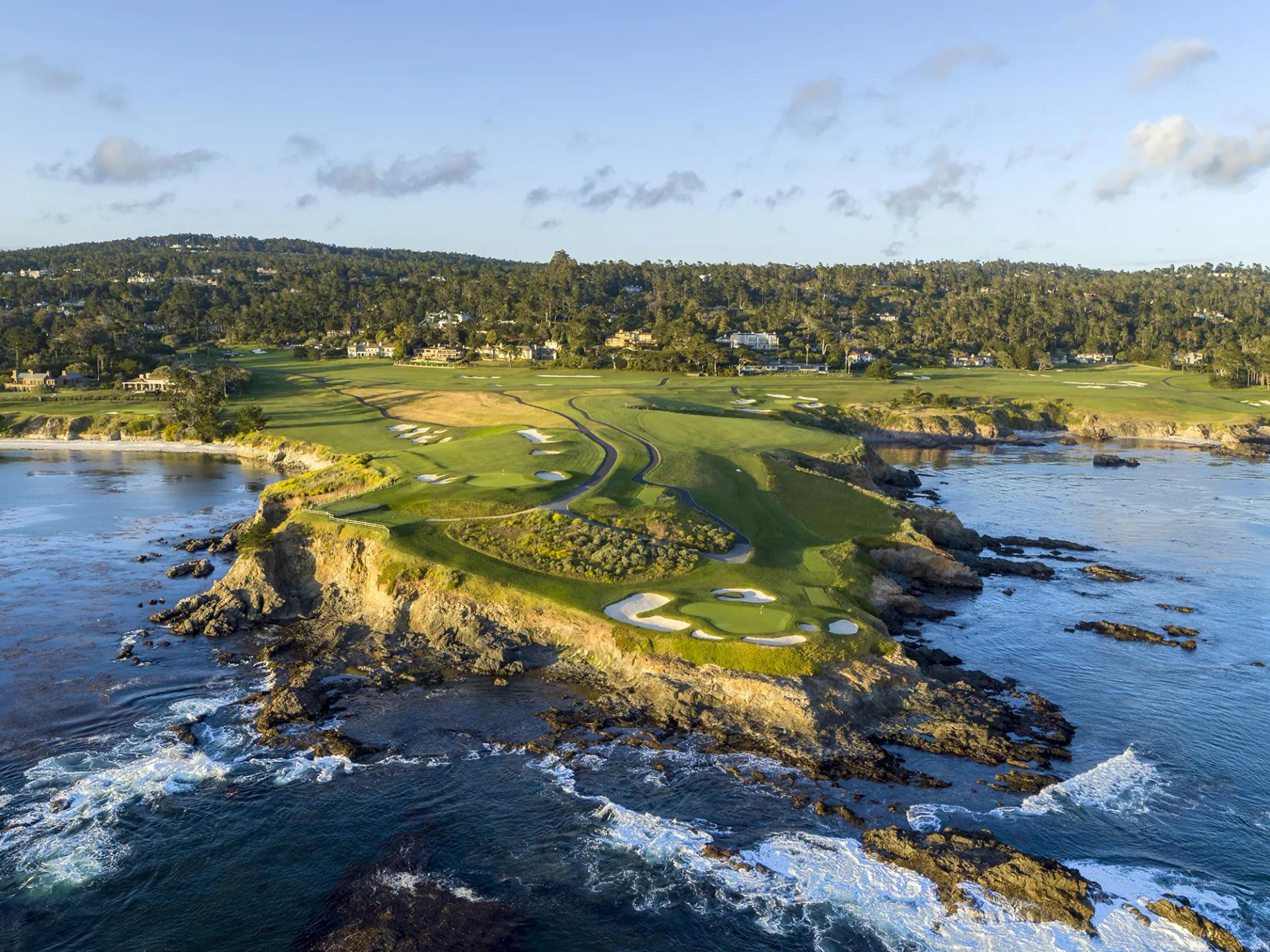
Jack Neville and Douglas Grant, both amateurs, laid out Pebble in 1919 with one aim: put as many holes on the bay as the land allowed. The ocean arrives at the 4th and is rarely far away after that. The yardage is modest, 6,802 from the Blues. The defense is the greens, averaging about 3,500 square feet by the operator's figures, smaller than any others on the PGA TOUR, with 118 bunkers around them and many tilting toward the water. It is a precision course that happens to be famous; take the operator's advice and walk with a caddie. The tour has stopped here every February since 1947, and the U.S. Open returns in 2027.
Spyglass Hill
Robert Trent Jones Sr. opened Spyglass in 1966. The first five holes run through sand dunes facing the ocean; then it heads into the Del Monte Forest and stays there. From the same Blue tees it is longer than Pebble at 7,026 yards and rated a notch higher, 75.3 with a 145 slope. The greens sit up on tiers and tilt hard, and the hole names come almost entirely from Treasure Island. The resort says no player broke 70 there at the 1999 U.S. Amateur, and it co-hosts the AT&T Pebble Beach Pro-Am each year.
Del Monte Golf Course
Del Monte opened in 1897, and by its operator's account no course west of the Mississippi has been in continuous operation longer. It sits in Monterey rather than the Del Monte Forest, and much of Herbert Fowler's 1920 redesign survives. At 6,356 yards from the Blues it relies on small, steeply sloped greens and out-of-bounds down the left of about half the holes. There is no driving range on site. It is the gentlest of the three and a good round for the day after Spyglass.
Poppy Hills: the forest without the resort
Poppy Hills is in the Del Monte Forest but belongs to the Northern California Golf Association, not Pebble Beach Company, and you pay no gate fee to reach it. Robert Trent Jones Jr. rebuilt it in 2013-14 and removed the rough entirely, leaving fairway, sandy native areas and bentgrass greens. It plays firm and fast through Monterey pines, 7,091 yards from the Jones tees, with borrowed ideas such as a MacKenzie-style hanging bunker at the 11th and a Redan at the 15th. Tee times open 90 days out. For a championship-length round in Pebble Beach without a hotel booking, this is the plainest answer.
The city courses: Pacific Grove and Seaside
Pacific Grove Golf Links
Pacific Grove Golf Links, owned by the city, is two courses in one. H. Chandler Egan, twice U.S. Amateur champion, designed the 1932 front nine through the pines. Jack Neville, Pebble's co-designer, added the back nine in 1960 in the dunes around the Point Pinos Lighthouse, with the ocean in view on every hole. At 5,732 yards and par 70 it is the shortest course here, priced at walking rates. For dunes golf by the sea without a resort bill, start with this back nine.
Bayonet and Black Horse
The City of Seaside owns both courses on the former Fort Ord Army base, and since a 2008 rebuild they play as deliberate opposites. Bayonet, built in 1954 by General Robert B. McClure, is the narrow one: 7,104 yards from the Blacks between oaks and cypress, with deep bunkers and Combat Corner, the string of hard doglegs from the 11th through the 15th. Black Horse, from 1964, is wide off the tee, with big serrated bunkers and far more movement in the greens. Both look out over Monterey Bay. A mixed group should start at Black Horse; a straight hitter will get more out of Bayonet.
Carmel and Carmel Valley
Quail Lodge & Golf Club
Quail Lodge & Golf Club in Carmel takes public play alongside its members. Robert Muir Graves routed it in 1964 around ten lakes and the Carmel River. Todd Eckenrode's 2015 renovation, which Sports Illustrated reported took Pasatiempo as its model, kept the Graves greens but cleared bunkers from the front corners so a miss can run on. It is 6,464 yards from the Blacks and an easy walk, though three of the par 3s play over 200 yards.
Carmel Valley Ranch
Carmel Valley Ranch is a resort course with a catch for outsiders: non-guests may book only after 1 pm. By the resort's account it is Pete Dye's only Northern California course. The opening nine runs beside the Carmel River, the closing nine climbs into the Santa Lucia foothills, and the whole thing is a short 6,117 yards. The resort also places it beyond the peninsula's fog belt, which makes it the sensible fallback when the coast is socked in.
Worth the drive: Pasatiempo and San Juan Oaks
Pasatiempo Golf Club
Across the bay in Santa Cruz, Pasatiempo is the region's MacKenzie course that a visitor can actually book. Marion Hollins, who also secured the land for Cypress Point, created it in 1929, and MacKenzie spent his last years in a house that still stands beside the 6th fairway. The club considers it the MacKenzie course closest to how he left it, and recent work has taken every green and bunker back to the 1929 plans. It is 6,495 yards and par 70 with a 143 slope, over sandy hills that climb in places, with each tee close to the previous green. Public times are set aside daily; members keep some, mostly early weekend mornings. If architecture is the point of the trip, this is the round to plan around.
San Juan Oaks Golf Club
Inland near Hollister, San Juan Oaks trades the coast for oak foothills cut by creeks. Fred Couples designed it with Gene Bates in 1996, and it reopened in late 2024 after roughly 30 months of renovation. It plays 7,071 yards from the Blacks, and the 8th tees off from nearly 200 feet above its fairway. Bates also reworked both Seaside courses and led the Carmel Valley Ranch renovation, so a good share of the region's public golf carries his hand.
The private clubs
Four courses here are for members and their guests only, with no public tee times. Cypress Point, Alister MacKenzie and Robert Hunter's 1928 course with the par-3 16th played across the Pacific, hosted the Walker Cup in 2025. Monterey Peninsula Country Club has two: the Dunes Course, Seth Raynor's routing rebuilt in 2016, and the Shore Course, Mike Strantz's 2003 redesign; the club is no longer in the AT&T Pebble Beach Pro-Am rotation. The Preserve Golf Club sits within the 20,000 acres of the Santa Lucia Preserve outside Carmel. None of them can be booked.
How to book
We don't sell tee times. Each course listing links to where you can.
- Pebble Beach Resorts: Pebble Beach Golf Links generally requires a stay at one of the resort's hotels; Spyglass Hill and Del Monte also book through the resort.
- Poppy Hills: directly with the course, up to 90 days ahead.
- Carmel Valley Ranch: through the resort; outside players after 1 pm.
- Everything else public: Pacific Grove, Bayonet, Black Horse, Quail, Pasatiempo and San Juan Oaks book through GolfNow or the course's own tee sheet. Pasatiempo's public times are limited, so book early.
- Cypress Point, Monterey Peninsula Country Club and The Preserve: members and their guests only.