
Best Courses
California's Courses on Golf Digest's 100 Greatest
The 14 ranked California courses in order, who can play each one, and the seven on the public list.
Updated · November 12, 2026
Golf Digest's America's 100 Greatest Golf Courses for 2025-26, published in May 2025, includes 14 courses in California. Most of them are private. Only three of the 14 sell tee times to visitors, and one of those generally comes with a hotel stay, so this piece also covers the magazine's companion list, America's 100 Greatest Public Courses, where California has seven entries. The order below is the national ranking, and it lines up exactly with Golf Digest's Best in State list for California, whose top 14 are the same courses in the same order. Every course we carry links to its page on this site, with its history, who can play it and, for the public courses, how to book.
No. 3: Cypress Point Club
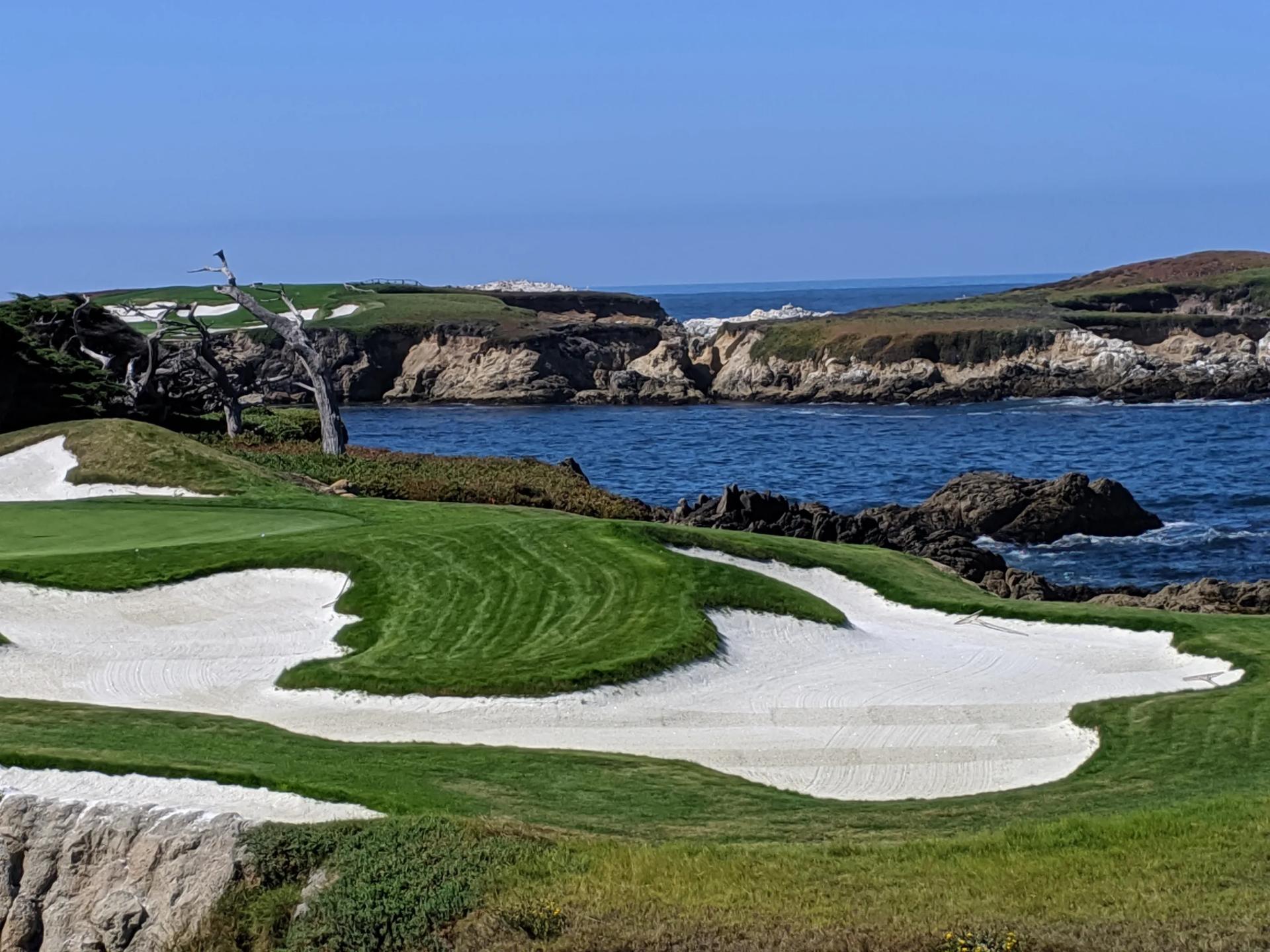
Cypress Point Club is the highest-ranked course in the state. The job first went to Seth Raynor, who died in 1926 with only preliminary plans done; Alister MacKenzie built it with Robert Hunter, and play began on 17-Mile Drive in August 1928. The routing moves from a wooded hillside through sand dunes to cliff-top holes, where the 233-yard par-3 16th is played across the Pacific from cliff to cliff. The club hosted the Walker Cup in 1981 and again in 2025. Cypress Point is a private club, played by members and their guests.
No. 9: Pebble Beach Golf Links
Pebble Beach Golf Links opened in February 1919, laid out by two amateurs, Jack Neville and Douglas Grant, and Neville's stated aim was to fit as many holes as he could along the bay. Its defense is precision rather than length: the operator puts the average green at about 3,500 square feet, the smallest on the PGA TOUR. The 2019 U.S. Open was its sixth, and more are scheduled for 2027, 2032, 2037 and 2044. Pebble Beach takes public tee times, and it is No. 1 on the public list, but the operator ties tee times to a hotel stay, so a round generally means a room at a Pebble Beach Resorts hotel. The course page explains how to book.
No. 16: Los Angeles Country Club, North Course
The Los Angeles Country Club's North Course plays into, through, out of and back into a dry canyon on the club's Wilshire Boulevard property, with a barranca winding through it. George C. Thomas Jr. redesigned the North in the 1920s, and Gil Hanse's restoration, unveiled in 2010, dug up buried greens and bunkers and returned the 2nd and 8th greens to their original sites. In 2023 it brought the U.S. Open back to Los Angeles for the first time since 1948, and Wyndham Clark won it. The North is a private club course, played by members and their guests.
No. 18: Riviera Country Club
Riviera Country Club lies in Santa Monica Canyon in Pacific Palisades. George C. Thomas Jr. designed it free of charge, over 18 months and 15 iterations, and it opened in 1927; his ideas include a bunker in the middle of the two-tiered 6th green and a drivable 10th whose narrow green is angled away from the fairway. Ben Hogan won the 1948 U.S. Open here. The Los Angeles Open, now the Genesis Invitational, has been played at Riviera in every year but two since 1973, and the club will stage Olympic golf in 2028. It is a private club, played by members and their guests, and a guest must be invited by a member.
No. 33: San Francisco Golf Club
San Francisco Golf Club covers 150 acres at the city's southern edge. A.W. Tillinghast's course opened in 1918, and it is his only original design west of Texas. There are no yardage markers and rangefinders are not permitted, so caddies and judgment do the work, while the bunkers dictate where each tee shot should finish. Tom Doak renewed the greens in 2001 and in 2006 restored the 13th through 15th, holes that had been reworked in 1950 for a planned freeway. It is a private club, played by members and their guests, and membership is by invitation only.
No. 35: The Olympic Club, Lake Course
The Olympic Club's Lake Course is the second Lake Course on the club's property near the Pacific: Sam Whiting designed it after the winter storms of 1925-26, and it opened in 1927. It has hosted five U.S. Opens, in 1955, 1966, 1987, 1998 and 2012, and the first of them, Jack Fleck's playoff win over Ben Hogan, set a pattern of upsets. Gil Hanse's 2023 renovation enlarged the greens by about 35 percent and widened the fairways by about 25 percent, yet the course still plays through tight corridors to small greens, with the 2028 PGA Championship and 2033 Ryder Cup ahead. It is played by members and their guests; membership is by invitation and requires sponsors.
No. 55: Monterey Peninsula Country Club, Shore Course
Monterey Peninsula Country Club's Shore Course lies between Cypress Point and the town of Pacific Grove. Mike Strantz, working with Forrest Fezler, reversed the direction of play and built 12 new seaside holes, turned toward the Pacific instead of away from it. He was battling cancer during construction and died soon after the course reopened. Five par 3s and five par 5s give the card an unusual balance, and David Zinkand's later renovation expanded the native fescue and waste areas. The Shore is private, played by members and their guests.
No. 57: California Golf Club of San Francisco
The California Golf Club of San Francisco, listed by Golf Digest as California Golf Club and known as Cal Club, opened on a hillside in South San Francisco in May 1926, with A. Vernon Macan as architect of record. Alister MacKenzie and Robert Hunter, retained in 1928, redesigned the bunkering and at least two greens. Kyle Phillips's 2007-08 renovation converted the course to fine fescue, so the fairways play fast and firm, and on a hillside that catches whatever wind is about, it changes from one day to the next. It is primarily a walking course at a private club, played by members and their guests.
No. 71: The Valley Club of Montecito
The Valley Club of Montecito, between the Santa Ynez Mountains and the Pacific, opened on December 30, 1929, the last course Alister MacKenzie and Robert Hunter designed together. At 6,750 yards from the Black tees it is short by modern measures, but nearly every green must be approached from the proper angle, and the bunkering seems to vanish when viewed back from the green. A 1996 master plan by Tom Doak and Jim Urbina led to the restoration of the original greens and bunkers, and member Fred Couples shot 59 here in 2004. It is a private club, played by members and their guests, and most members walk.
No. 76: Spyglass Hill Golf Course
Spyglass Hill Golf Course opened on March 11, 1966, designed by Robert Trent Jones Sr. with his son, Robert Trent Jones Jr. The first five holes play through sand dunes with ocean views before the course turns into the Del Monte Forest for good, and nearly every hole is named for a place or character in Treasure Island. Raised, tiered and sharply sloped greens supply most of the defense, and from the Blue tees it rates 75.3 with a 145 slope, a shade harder than Pebble Beach. Spyglass Hill is open to the public, run by Pebble Beach Resorts, and No. 13 on the public list; its course page explains how to book.
No. 77: Monterey Peninsula Country Club, Dunes Course
Monterey Peninsula Country Club's Dunes Course pairs a 1920s routing with a modern rebuild. Seth Raynor routed it in 1924 but died before it was finished, and Robert Hunter oversaw its completion; Tom Fazio and Jackson-Kahn Design rebuilt it, and it reopened on May 1, 2016. Holes 1 to 8, 17 and 18 run through forest, while the 9th to 16th cross sand dunes toward the Pacific, and the par-3 14th is played over the ocean to a green framed by a single transplanted cypress. Like the Shore, it is private, played by members and their guests.
No. 83: Ladera Golf Club
Ladera Golf Club in Thermal is the newest of California's 14: Gil Hanse and Jim Wagner opened it in 2023, at the base of the Santa Rosa Mountains. The 300-acre site was once level farmland, lemon groves and mango farms. The architects moved millions of cubic yards of earth, raising the low side so the holes look out across the valley floor toward the Mecca Hills. Fairways run 60 to 100 yards wide with no formal rough, and several tee shots carry diagonally over barrancas and bunkers. Ladera is a private club, played by members and their guests.
No. 85: The Quarry at La Quinta
For more than half a century, The Quarry at La Quinta was the Keller Pit, a county mine and gravel pit. Founder William Morrow hired Tom Fazio, crews moved more than 1.2 million cubic yards of earth and planted more than 4,000 trees, and the course opened in 1994. It starts and finishes on the floor of the old pit, crosses a central plateau and, midway through the back nine, climbs into a canyon notch of the Santa Rosa Mountains. Membership is by member invitation only, and it is a private club, played by members and their guests.
No. 93: Pasatiempo Golf Club
Pasatiempo Golf Club in Santa Cruz opened on September 8, 1929, with Marion Hollins, who announced the project and hired Alister MacKenzie, in the first group alongside Bobby Jones, Glenna Collett and Cyril Tolley. MacKenzie spent his last years living beside the course, in a house that still borders the 6th fairway, and he considered the 16th his favorite two-shot hole. A recent project returned every green and bunker to the 1929 design. Pasatiempo is semi-private and No. 15 on the public list: it sets aside public tee times every day, with some times, mainly early weekend mornings, kept for members, and the course page has how to book.
The public list: where visitors can book
Golf Digest's America's 100 Greatest Public Courses for 2025-26 is the more useful list for planning a trip, and California has seven courses on it. Three appear above: Pebble Beach at No. 1, Spyglass Hill at No. 13 and Pasatiempo at No. 15. The other four follow in rank order, and one of them is closed until 2027.
At No. 40, Torrey Pines South is the City of San Diego's course on the La Jolla bluffs, planned by William P. Bell and completed by his son, William F. Bell, on land that had been the Army's Camp Callan. It opened in 1957, hosted the U.S. Open in 2008 and 2021, and stretches to 7,802 yards from the Black tees. It takes public tee times, sold online or in person, and non-residents can book up to 90 days ahead; the course page has how to book.
At No. 52, CordeValle is Robert Trent Jones Jr.'s course in San Martin, about 30 minutes south of San Jose, laid out in 1999 through oak-studded foothills of the Santa Cruz Mountains on a 260-acre property with no real estate. It hosted the PGA TOUR's Frys.com Open from 2010 to 2013 and the 2016 U.S. Women's Open. Access is for resort guests and members only: non-members can play only while staying at the resort.
At No. 54, The Links at Spanish Bay has been closed since March 2026 for a redesign and is scheduled to reopen on April 17, 2027. We are holding its page until it reopens, so it has no link here.
At No. 62, the PGA WEST Stadium Course in La Quinta is Pete Dye's 1986 layout, the first course at PGA WEST, and it co-hosts The American Express each January with the Nicklaus Tournament Course. Its island-green 17th, Alcatraz, is where Lee Trevino made a hole-in-one in the 1988 Skins Game, and Tim Liddy's restoration reopened the course in September 2024. It takes public tee times, La Quinta Resort guests can book up to a year ahead, and the course page has how to book.
Beyond the rankings
The national lists favor private clubs, and California's public golf runs well past these seven courses. Browse every course we cover in the course directory, and for booking windows, resident and non-resident systems, and resort-guest rules, see our California golf guides.